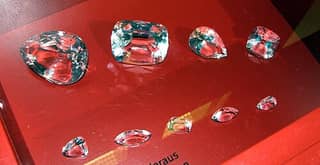
The world's largest diamond was sent away as an ordinary parcel—the Cullinan Diamond
The Cullinan rough stone weighed 3,106 carats, making it the largest gem-quality diamond ever discovered. It is often said to have been found on January 26, 1905, at the Premier Mine in South Africa, and was named after mining company chairman Thomas Cullinan. In 1907 it was purchased by the Transvaal government and presented to King Edward VII; in 1908 in Amsterdam it was cleaved by Asscher into 9 major and 96 smaller stones, 105 in total. The two largest are now set in the British sovereign's sceptre and the Imperial State Crown, displayed at the Tower of London. The story that it was "sent by registered mail" is a famous "it is said."
Let's start with that anecdote. One story goes: when the diamond was shipped from South Africa to England in 1907, the one paraded onto the ship under police escort was a decoy, while the real stone traveled to London in an ordinary parcel sent by registered mail. The tale is widely repeated, but it counts only as "one story," not as fact. It's a good story because the stone really was absurdly large.
In 1905 (often cited as January 26), Frederick Wells, the manager of the Premier Mine in South Africa, spotted a glint on the pit wall and dug out a rough stone weighing 3,106 carats (about 621 grams) and roughly 10 centimeters long. Named after mining company chairman Thomas Cullinan, it remains the largest gem-quality diamond ever found.
In 1907, the Transvaal colonial government bought it and presented it to King Edward VII. Accounts of the purchase price differ, so no figure is given here.
The hard part was how to cut it. In 1908, the Joseph Asscher firm of Amsterdam took on the job. One story says the blade broke on the first cut; another says the cutter fainted on the spot after making it. These are anecdotes, marked as "one story." What is certain is the result: the rough was cleaved into 9 large diamonds and 96 smaller ones, 105 stones in all, with a total finished weight of about 1,063.65 carats—only about a third of the original rough.
The largest is called Cullinan I, also known as the "Star of Africa," 530.2 carats (some sources say 530.4), the largest colorless cut diamond in the world. In 1911, the crown jewelers Garrard set it into the Sovereign's Sceptre, made for the coronation of Charles II in 1661. The stone was so heavy that the sceptre had to be specially reinforced; the mount has a hinge, so the diamond can be removed and worn on its own.
The second largest, Cullinan II, 317.4 carats, is set in the front of the Imperial State Crown—just below the "Black Prince's Ruby" from the previous piece. On the same crown, a spinel misnamed for centuries sits above a diamond that was supposedly sent as a parcel.
The remaining numbered large stones (III through IX) were first given to Asscher as payment for the cutting, then gradually returned to the royal family; they are now part of the monarch's private jewelry and are not displayed with the crown.
Next time you see that big diamond atop the sceptre in the Tower of London, remember where it came from: a 3,106-carat stone, cut into 105 pieces, the two largest guarding Britain's sceptre and crown. As for whether it reached England by mail coach—that's just one story; diamonds don't talk.
(Image: replicas (not the originals) of the Cullinan rough and some of the cut stones, Wikimedia Commons, CC BY-SA 3.0. Sources: Royal Collection Trust "The Cullinan Diamond," RCIN 31712 Sovereign's Sceptre, RCIN 31701 Imperial State Crown; Scarratt & Shor's study of Cullinan I and II in GIA's Gems & Gemology, Summer 2006. This is the fifth piece in the picture-story series; the first four: the Mao Gong Ding, the Jadeite Cabbage, Fan Kuan's Travelers Among Mountains and Streams, and the Black Prince's Ruby. The registered-mail account of the real diamond is "one story.")
- Royal Collection Trust:库里南发现、切割、Cullinan I/II 镶嵌、III–IX 归属
- RCT RCIN 31712 君主权杖:1661 查理二世、1911 Garrard 镶 Cullinan I、加固、铰链可拆
- RCT:Cullinan I、II 分别镶君主权杖与帝国皇冠
- GIA Gems & Gemology 2006 Vol.42 No.2:3106 ct 原石;Cullinan I 530.20 ct、Cullinan II 317.40 ct
- Wikimedia Commons 图:原石与切成品复制品,CC BY-SA 3.0(imageId i-6a2524e03e11)
