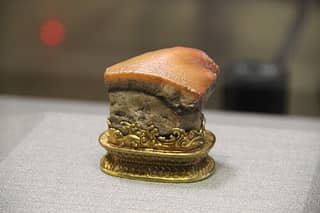
Nature mixed the colors, a craftsman finished the brushwork: the mouth-watering stone at the National Palace Museum in Taipei
Qing dynasty Meat-shaped Stone, accession no. 故雜000178; the collection page records a length of 7.9 cm and an overall height of 6.6 cm; the material, per the museum's own wording, is chalcedony-type jasper. The layered veining grew naturally into lean and fat; the surface was finely drilled with dots to make pores, and the upper layer dyed brownish red to make the skin. Its origin is often cited as Alxa Left Banner, Inner Mongolia (not recorded by the museum, hence marked "often cited"). Colloquially one of the "Three Treasures of the Palace Museum" (alongside the Jadeite Cabbage and the Mao Gong Ding), it is shown in rotation between the National Palace Museum's northern branch and its southern branch.
First, the most counterintuitive layer: it is neither entirely natural nor entirely man-made. The lean-and-fat layers and the color-peak veining are what chalcedony-type jasper grew naturally over long ages; but the pores and the skin were made by Qing dynasty craftsmen—finely drilling dots into the surface both to create the pore effect and to make the top layer crumbly and easy to dye, then dyeing the upper layer brownish red, like meat skin soaked in soy sauce. Nature lays the base, human hands add the finishing touch; without either layer it wouldn't look right. This is also what distinguishes it from #2 in this series, the Jadeite Cabbage: the cabbage relies on clever carving of the jade's colors, while this relies on "the layered veining of a half-finished piece + the finishing dots and dye."
The museum uniformly writes the material as "chalcedony-type jasper" (the southern branch's highlights selection and the collection notes use the same wording); don't mix it up with "agate-type chalcedony" as if there were two versions. Dimensions follow the collection and 3D appreciation pages: length 7.9 cm, overall height 6.6 cm, accession no. 故雜000178. Its origin is often cited as Alxa Left Banner, Inner Mongolia, with one account saying it was presented by Abao, the Jasagh of Alxa, during the Kangxi reign of the Qing dynasty—the museum's main text does not record the origin, so the origin is only marked "often cited / one account," not treated as settled. The online claim that "Yongzheng loved it most" has no official source, so it is not written.
The display method must also be stated correctly: it is not a "permanent exhibit, never rotated." Like the Jadeite Cabbage, the Meat-shaped Stone is shown in rotation between the National Palace Museum's northern branch and its southern branch (Chiayi); the museum's "Treasures of the North and South Branches Gathered Together" feature updates each one's schedule on a rolling basis. In 1949 it moved to Taiwan with the Palace Museum artifacts. In 2014, for the "Masterpieces from the National Palace Museum" exhibition in Japan: the Jadeite Cabbage was shown at the Tokyo National Museum for only about two weeks (June 24–July 7) before being shipped back; the Meat-shaped Stone, however, was lent out for display for the first time at the Kyushu National Museum, shown for about two weeks starting October 7—don't write the opening-day queue scene in Tokyo as if it were the Kyushu opening.
Hook: the colloquially named "Three Treasures of the Palace Museum" make up a table—the cabbage, the Mao Gong Ding, and this piece of braised pork; viewers simply call it a "pickled cabbage and pork hot pot." Scholars dispute the "Three Treasures" label; here it is only written as "colloquial," without endorsing it. The stone can't be eaten, but it's been tempting people for a hundred years.
(Image: photographed by Gary Todd, CC0, Wikimedia Commons. This is #9 in the picture-story series, the Meat-shaped Stone; earlier entries include the Mao Gong Ding, the Jadeite Cabbage, and others. Material, dimensions, and the drilled dots and dyeing are based on the National Palace Museum's collection / 3D appreciation / southern branch selection; the north-south rotation is based on the museum's North and South Branch Treasures feature; the 2014 Japan loan is based on announcements from the Tokyo National Museum and the Kyushu National Museum and China News Service reports.)
- 台北故宫典藏:故雜000178、长7.9公分通高6.6公分、碧石类矿物、钻点染色工艺说明
- 台北故宫3D赏析:清肉形石、H.6.6cm L.7.9cm、jasper/碧石加工与染色
- 故宫南部院区精彩选件:材质「玉髓类碧石」、层叠纹理与钻点染色
- 馆方北院南院珍宝齐聚:肉形石与翠玉白菜在南北院区轮流展出的档期更新
- 东京国立博物馆:2014神品至宝、翠玉白菜展期2014-06-24至07-07(东京限定)
- 九州国立博物馆:2014神品至宝10-07开幕、肉形石约展至10-20
- 中新社2014-10-07:肉形石九州首度外借、展约两周
- 配图:Gary Todd,CC0,Wikimedia Commons(imageId i-0a5e5f760706)
_(27228557209).jpg)