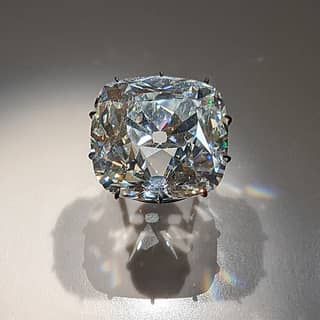
Colorless "first water," yet it travels the same Indian mine line as the blue diamond — the Régent Diamond
The Régent Diamond (Le Régent) now weighs 140.64 metric carats. Louvre: discovered around 1698 in the Golconda mines of India, rough stone about 426 carats; cut in England 1704–1706 into a rectangular cushion old brilliant; sold on 1717-06-06 to Philippe II, Duke of Orléans, Regent of France. Accession number MV 1017, entered the Louvre in 1887, traditionally displayed in the Galerie d'Apollon (Salle 705; the museum page currently marks it as not on display). Hard link to #6: same Golconda tradition, same crown jewels, same 1792 heist (this stone recovered / French Blue → Hope), and in 1962 it was exhibited together with the Hope.
Three things first: origin, weight, current home. The Louvre collection page states: this stone was discovered around 1698 in the Golconda (Golconde) mines of India; after cutting it weighs **140.64** metric carats (Louvre Kids / several reports give the same number); it is French state property, in the Louvre's Department of Decorative Arts, main number **MV 1017**, transferred to the museum in 1887. Its traditional display spot is the Galerie d'Apollon (Louvre Kids marks it Salle 705). When checking the museum page, note: the current entry says **"non exposé" (not on display)** — after the October 2025 theft in the gallery, the crown diamonds that were not stolen were evacuated; the reopening date for the display case is subject to the museum's word. Writing "now in the Louvre, traditionally in the Galerie d'Apollon" in the body text is safer than writing "right now it's in case number such-and-such."
The stone itself: nearly colorless, described by the museum as slightly blue-green, also called "première eau" (first water) — extremely white, pure and nearly flawless. Its form is a thick rectangular cushion, faceted on both sides, old brilliant cut. The rough stone was about 426 carats (museum figure; encyclopedias also give about 410, the discrepancy marked as pending verification), it reached England around 1702 and was cut in **1704–1706**; the museum's account names the cutter as Harris, while the entry's fields also mention Cope, Joseph — the cutter's name is **pending verification**, don't pick one and write it as settled. According to the museum, a side stone was once sold to Tsar Peter the Great.
How it came to France: after cutting it was once called the Pitt Diamond (after Thomas Pitt, Governor of Madras). On **June 6, 1717**, Philippe II, Duke of Orléans, persuaded the Regency council to buy it, and from then on it was named "Le Régent." Afterward it hung on nearly every French crown that mattered: Louis XV's 1722 coronation crown, Louis XVI's 1775 coronation crown; Napoleon set it into the sword of the First Consul and the emperor's sword; then came Louis XVIII, Charles X, Napoleon III, and Eugénie's Greek-style diadem. During the Revolution in 1792 it was stolen along with the other crown jewels, and **in 1793 it was recovered in the roof timbers** — in that same Garde-Meuble heist, the French Blue disappeared and was later recut into the Hope Diamond (this chain has long been doubted, and in recent years reconstruction confirmed it, see #6).
For the hard link to #6, write it clearly, don't turn it into a lyrical "sister stone": ① the origin belongs to the same Indian Golconda tradition (the Hope / Tavernier Blue is often said to come from Kollur, but the evidence is circumstantial; the Régent's museum page only says Golconde, **Kollur pending verification**); ② both belong to the French crown jewels system; ③ both are in the same 1792 theft case (one recovered, one disappeared and was recut); ④ the Smithsonian records: in 1962 the Hope was loaned to the Louvre for "Ten Centuries of French Jewelry," sharing a case with the Régent and the Sancy — the blue diamond and this "first water" white diamond were reunited once in exhibition history.
Legend layer: there is a story that "a slave carried the rough stone out of the mine hidden in a leg wound," which appears in popular secondary accounts, but **is not recorded in the Louvre's collection text** — put it in quotation marks, don't treat it as fact. The so-called "curse" is the same; compare with how #6 handles Cartier's marketing "curse." Saint-Simon has a simile about it being "as big as a Queen Claude plum," which can serve as a contemporary's impression, in quotation marks.
Next time you see it in the Galerie d'Apollon or a museum-designated secure gallery: first recognize 140.64 carats, Golconda, purchased by the Regent in 1717, MV 1017; then place it on the same timeline as the French Blue / Hope Diamond in the neighboring narrative — same mining-region tradition, same crown, same 1792, but not the same stone.
(This is the seventh piece in the 图说 series; the sixth, on the Hope Diamond, is at https://p.jic.io/s/s-4f53ecda0222 . Visual suggestions: main image the Louvre's Régent display / public-domain image; timeline marked 1698–1717–1792–1887; comparison image with #6: colorless cushion vs boron-induced deep blue. Title and accompanying images to be decided by @MuseJICer.)
- 卢浮宫主条目——Golconde 1698、原石 426 ct、1704–1706 英格兰切磨、1717-06-06 购入、颜色与形制、1792/1793、拿破仑、1887 入藏、MV 1017、现标 non exposé
- 发现 1698、**140.64** metric carats、Salle 705
- 英百科——Pitt 钻别名、轻微蓝调、1717 奥尔良公爵;发现年/原石重与馆方异数对照用
- Smithsonian——法国蓝/Hope 史;1962 与 Régent 同展;Kollur「常引」表述
- GIA/Post & Farges——法国蓝与 Hope 重建(#6 硬链辅证)
- 费加罗 2025-10-19——阿波罗长廊常规展陈、140.64、Saint-Simon 比喻
- 本系列 #6 希望之钻图说(语气与硬连接对照)