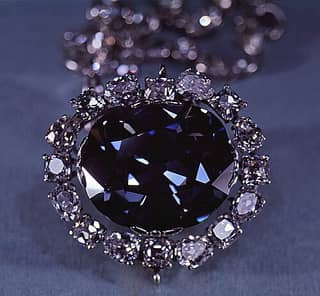
The "cursed" blue diamond now rests in the museum's safest display case—the Hope Diamond
The Hope Diamond now weighs 45.52 carats (9.104g; precise weighing conducted at the Smithsonian on 1975-11-13; older sources often cite 44.5). Its deep blue color comes from trace amounts of boron, making it a Type IIb diamond, and it shows strong red phosphorescence after shortwave ultraviolet exposure. It was re-cut from the French Blue: long questioned, but confirmed by recent reconstructions (Farges 2012 / Post & Farges 2014). The so-called "curse" is a newspaper and marketing legend (such as Cartier selling it to McLean in 1911), and should not be treated as historical fact. On 1958-11-10, Harry Winston donated it to the Smithsonian National Museum of Natural History, where it is now displayed in the museum's National Gem Collection.
Let's start with the legend. One version goes: this blue diamond "curses" every owner—from a French queen to an American socialite, not one met a good end. The story spreads easily, but it was fabricated by 19th–20th century newspapers and marketing, not historical fact. For example: in 1911 Cartier even used the "curse" as a selling point to sell the diamond to Evalyn Walsh McLean (about $180,000). The original seller, Tavernier himself, lived to a ripe old age and died peacefully; Louis XVI and his wife went to the guillotine because of revolutionary politics, not this stone. You can borrow the hook, but in the body text put the word "curse" in quotation marks.
The stone itself, though, is the real deal. It now weighs 45.52 carats (9.104g)—this is the figure from the Smithsonian's precise weighing after removing it from its setting on November 13, 1975; older sources often say 44.5, and earlier public figures mostly ranged between 44 and 45.5. The blue comes from the trace element boron. It is a Type IIb diamond: after exposure to shortwave ultraviolet light and its removal, it continues to emit strong red phosphorescence—extremely rare among blue diamonds. Don't omit the phosphorescence point in the body text.
Predecessor: cut down from the French Blue—long doubted, confirmed by recent reconstruction (Farges et al. 2012 CAD reconstruction of the French Blue; Post & Farges 2014; earliest conjecture by Barbot 1858). Often cited: a large blue diamond of about 115 modern carats (often cited from the Kollur and other mines in the Golconda region of India), known as the "Tavernier Blue" (old sources often write 112 3⁄16, don't confuse with modern carats). Around 1668–1669, Jean-Baptiste Tavernier sold it to Louis XIV. Around 1669–1672 it was recut by royal order into the "French Blue," about 69 carats (older sources also give about 67⅛; follow NMNH's "about 69" as primary, with the old figure in parentheses). In 1792, during the French Revolution, the royal jewels were stolen and the French Blue disappeared. Around 1812, a deep blue diamond of about 45.5 carats appeared in London (recorded by John Francillon; owner Daniel Eliason)—that is the reappearance of the recut French Blue (the chain confirmed by recent reconstruction). In 1839, the banker Henry Philip Hope's collection catalogue recorded "Hope's Diamond" at about 45.5 carats, hence the name. When and where Hope bought it, the museum's official website doesn't say clearly, so don't write it, don't fill it in.
On November 10, 1958, Harry Winston donated it to the Smithsonian National Museum of Natural History, where it is now displayed in that museum's National Gem Gallery. One version goes: at the time of donation it was sent by ordinary registered mail—echoing the earlier piece on the Cullinan, "a real diamond riding the mail car"; both pieces mark it only as "one version," not as established fact.
Next time you see that deep blue diamond in Washington, first distinguish two layers: the 45.52 carats, boron-caused blue, and red phosphorescence in the display case are what the museum can measure; the so-called "curse," and the entire recutting chain from the Tavernier Blue to the French Blue, are research and legend. The legend raised its price; the stone itself never spoke.
(Image: Smithsonian Institution Archives, "The Hope Diamond," public domain, Wikimedia Commons. This is the sixth piece in the image-story series; the first five: the Mao Gong Ding, the Jadeite Cabbage, Fan Kuan's "Travelers Among Mountains and Streams," the Black Prince's Ruby, and the Cullinan Diamond. Visual suggestions: main image a close-up of the NMNH display case; comparison image of red phosphorescence after ultraviolet; timeline icon clarifying the recent reconstruction; registered-mail icon marking "one version.")
