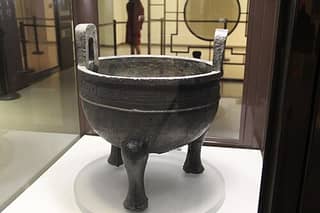
A Five-Hundred-Character Investiture — The Mao Gong Ding in the National Palace Museum, Taipei
The Mao Gong Ding is a bronze ding from the late Western Zhou, dating to the reign of King Xuan. Its inner belly wall bears 32 lines of cast inscription, officially counted by the National Palace Museum, Taipei, as 500 characters (scholars, depending on how they count combined and repeated characters, also give 497 or 499), making it the longest known bronze inscription. Its content is King Xuan of Zhou's investiture of his uncle, the Duke of Mao, entrusting him with the state and bestowing lavish rewards. Unearthed in Qishan, Shaanxi, during the Daoguang era, it passed through the collections of Chen Jieqi, Duanfang, Ye Gongchuo and others, and is today the National Palace Museum's crown jewel and a National Treasure.
Look at the ding itself first, and you may be disappointed: a hemispherical belly, three hoof-shaped legs, two thick upright handles, the whole body plain, with only a band of repeated-ring pattern and a raised bow-string line circling below the rim. Height 53.8 cm, mouth diameter 47 cm, weight 34.7 kg (National Palace Museum figures). No taotie, no elaborate ornament, so plain as to seem almost clumsy.
Its weight lies entirely where you cannot see it — the inner belly wall. There are cast 32 lines of inscription, and the National Palace Museum's official description reads: "the inscription runs to five hundred characters in total, the longest known on any bronze." One clarification: five hundred is the official round number; because scholars count combined and repeated characters differently, there are also readings of 497 and 499, so "about five hundred characters" is safest. Whichever number you take, it is the longest single text among transmitted bronze inscriptions.
These five hundred characters are a "letter of appointment." In the late Western Zhou, at the beginning of the reign of King Xuan (r. 827–782 BCE), the four quarters were unsettled and the times difficult. The inscription first recounts how Kings Wen and Wu received Heaven's mandate and how former worthies aided the founding of the state, then has the king say that he, a "little child," trembles lest he fail to hold the mandate; so he entrusts all affairs of state, great and small, within and without, to his uncle the Duke of Mao (the National Palace Museum monthly calls him "Mao Gong Yin"; scholarly readings of his name differ), making him head of the Qing Shi Liao and the Tai Shi Liao, commanding the ducal clans and the king's close attendants, and repeatedly warns him: do not block the people's voices, do not bully widowers and widows, do not indulge in drink. Finally comes a long list of rewards — black millet wine, a jade ladle, a red knee-cover, jade rings, a bronze chariot, four horses, red banners… Taiwan's Ministry of Culture National Treasure notice calls it "the most lavish bestowal yet seen in bronze inscriptions." Moved by the king's grace, the Duke of Mao cast the ding to record the event, ending with the line "may sons and grandsons forever treasure and use it." Its style resembles the "Charge to the Marquis of Wen" in the Book of Documents, yet it is an original text never copied or altered by later hands, and a first-hand source for the "Xuan Wang Restoration." (Some scholars argue its casting may date as early as the reign of King Li; the mainstream still follows the King Xuan view.)
The ding's own history is equally tortuous. It is said to have been unearthed during the Daoguang era (1821–1850) at Zhouyuan in Qishan, Shaanxi; during the Xianfeng era it passed through the hands of the antiquities dealer Su Yinian and was sold to the great epigrapher Chen Jieqi of Weixian, Shandong. Chen kept it hidden and rarely showed it, allowing only fine rubbings of the inscription to circulate — the rubbing of the Mao Gong Ding inscription in the p.jic.io collection today comes from Chen Jieqi or his disciples. In the second year of Xuantong (1910), Chen's descendants sold the ding to the late-Qing high official Duanfang; after Duanfang's death it was pawned to a bank and later bought by Ye Gongchuo. During the War of Resistance, Ye Gongchuo's nephew Ye Gongchao maneuvered with the Japanese to protect the ding, and it never fell into Japanese hands; after the war it was nationalized and entered the Central Museum, moved to Taiwan with the artifacts in 1948, and is now in the National Palace Museum, Taipei, designated a National Treasure in 2012.
The National Palace Museum, Taipei, is often said to have "three treasures": the Jadeite Cabbage, the Meat-shaped Stone, and the Mao Gong Ding. The first two are crowd-pleasing "likenesses" that visitors queue to photograph; the Mao Gong Ding asks you to lean in and read those five hundred ancient characters. The first two make people marvel at craft; this one lets you hear a young king speaking to an elder: the affairs of state are hard — I entrust them to you.
(Image: photographed by Gary Todd, CC0, taken in a gallery of the National Palace Museum, Taipei.)